Finding a dress

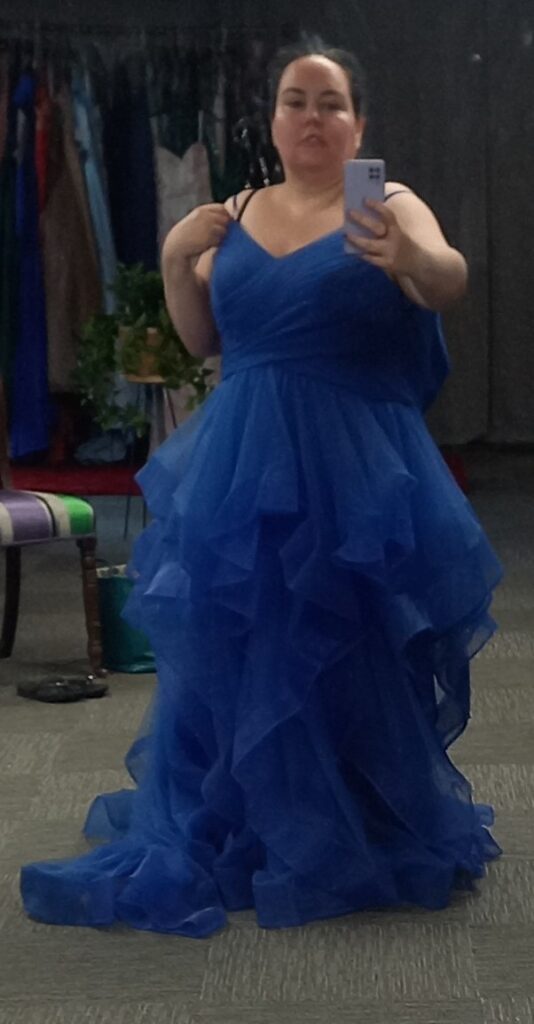
I needed to find a dress for Jane Austen’s birthday party. After a costume store failed, I found a dress hire place.

Things didn’t start out great. The internet told me Attire for Hire was in the Johnsonville Mall. It was not.

Eventually after circling the block, the directions pointed across the carpark where I spotted a sign. Unfortunately once I got there I couldn’t figure out how to get into the building as the most obvious entrance showed only two businesses, neither the one I was looking for.

After a panic attack on the stairs above the car park at the back of the building, I was rescued by Judy.

This is how you get into the building:

(Filmed after my appointment) To make it easier for others to find…

Thankfully Judy wasn’t annoyed and showed me into the space. Rows of gorgeous dresses line the walls, on a shelf many sparkly accessories rest, in the dressing area there are shoes that look supremely uncomfortable.

The first dress I tried on was exactly what I had envisioned; blue, ridiculously large skirt…but it didn’t fit. Considering the thin staps and how much I would have stumbled over that skirt, it’s a good thing the back wouldn’t do up.

Judy had pulled several sparkly dresses for me to try, the bronze one though not in my colour she’d intuited I’d like after our phone call. She was right, if only it had a lower back. Each of them was gorgeous! One would need the straps adjusted and two of them I’d need to wear a strapless bra, not really an option when you’re endowed like me (despite a reduction!). Additionally, they all would have been uncomfortable to wear for several hours, especially as I’d worry about catching the beading and/or sequins.

The dress I chose was the first I tried on. Judy hadn’t pulled it for me to try originally but she grabbed it the moment I walked in. She is a genius. It’s not the huge skirt, sparkly dress of my dreams but it felt right. Not only could I move with ease, I felt like me (at one point I had a dress with a similar skirt), I felt comfortable, would be able to run around organising all evening and it was still gorgeous. Bonus points for it matching my hair. Just look how happy I am trying it on.

Running events and being a “public face” (urgh hate that term) is difficult for someone like me who prefers to sit in the back row and listen intently. Getting my hair and makeup done professionally plus picking glorious outfits eases some of the stress – not only do I not have to do all that work myself, it gives me the confidence that even if I screw up, I look mighty fine doing it!

Audio throughout is myself and Judy talking plus The Life of a Showgirl by Taylor Swift (I was in the top 0.01% of listeners in 2025)

The Gardiners knew

When the Gardiners meet Mr Darcy in the company of Lizzy at Pemberley she is relieved to have “some relations for whom there was no need to blush.” Swiftly Mr Darcy brings his sister to meet them and the Gardiners recognise “that there was no other way of accounting for such attentions from such a quarter than by supposing a partiality for their niece.” During the visit they determine that Mr Darcy “was overflowing with admiration” for Lizzy, concluding with “it was evident that he was very much in love with her.”

Mrs Gardiner wishes to know the full truth of the matter especially when it appears Lizzy has told Mr Darcy about Lydia’s elopement (a circumstance they would try to keep as secret as possible).

Oh, that I knew how it was!

Both Gardiners consider there was some sort of understanding between the two or “would never have yielded” to allow Mr Darcy to organise Lydia’s marriage.

Video from Pride and Prejudice 1995 / Audio from Cassandra by Taylor Swift

The last line of the novel is devoted to the Gardiners:

With the Gardiners they were always on the most intimate terms. Darcy, as well as Elizabeth, really loved them; and they were both ever sensible of the warmest gratitude towards the persons who, by bringing her into Derbyshire, had been the means of uniting them.

Book a time to discuss Austen with me

Published
Categorised as Austen

Schrodinger’s Rapist

On a recent episode of The Amateur Austenite I spoke about my theory of Schrodinger’s Rapist in relation to Mr Elton and Mr Collins. Already similar characters as they are male, clergymen, full of themselves, and determined to do well, when they propose to the protagonist of the novel in which they exist they are both revealed to be what I call Schrodinger’s rapists.

SHELDON: … in 1935, Erwin Schrodinger, in an attempt to explain the Copenhagen interpretation of quantum physics, he proposed an experiment where a cat is placed in a box with a sealed vial of poison that will break open at a random time. Now, since no-one knows when or if the poison has been released, until the box is opened, the cat can be thought of as both alive and dead.

PENNY: I’m sorry, I don’t get the point.

SHELDON: Well of course you don’t get it, I haven’t made it yet. You’d have to be psychic to get it, and there’s no such thing as psychic.

PENNY: Sheldon, what’s the point?

SHELDON: Just like Schrodinger’s Cat, your potential relationship with Leonard right now can be thought of as both good and bad. It is only by opening the box that you’ll find out which it is.

The Big Bang Theory, Series 01 Episode 17 “The Tangerine Factor”

This interaction from The Big Bang Theory sitcom was my introduction to Schrodinger’s Cat. But I had vague recollections of a similar story in Anne of Green Gables (actually a sequel called Anne of the Island, which I didn’t recollect reading). Anne and her friends attempt to gas a stray cat, but it doesn’t go to plan.

..when the box was lifted in the morning, Rusty bounded at one gay leap to Anne’s shoulder where he began to lick her face affectionately. Never was there a cat more decidedly alive.

“Here’s a knot hole in the box,” groaned Phil. “I never saw it. That’s why he didn’t die..”

Till they take the box off the cat, they assume that the cat is dead. It’s been enclosed in a box with gas, surely it will die. But they hadn’t considered all the circumstances, they didn’t know about the knot hole in the box.

What does that cat have to do with Mr Elton and Mr Collins?

Like Sheldon explains to Penny, a potential relationship “can be thought of as both good and bad.” You could say the same about men, we don’t know how they’ll react till they’re in the situation.

Rape is non-consensual sexual contact. Would Mr Elton or Mr Collins go so far? We don’t know. What we do know, is that they both refuse to hear no, when quite clearly spoken by the woman they are proposing to.

Emma’s situation is particularly precarious, trapped alone in a carriage with a man who refuses to listen to her then acts like a petulant child when she finally gets through to him. Lizzy at least is in her parents home which, despite her mothers wishes, offers some level of protection.

Had Pride and Prejudice and Emma been written by another author these scenes may have developed very differently. Consider Tess of the d’Urbervilles a novel about a woman being blamed, scorned and ostracised for a physical act she did not consent to. That is literally the whole point of the book, I still can’t understand why we’d read it (I read it for university), let alone consider it a classic.

Perhaps Austen is commenting on clergymen, supposed to be pillars of society but more interested in aggrandising themselves. Or she may be reminding us that we can’t trust even those who have a direct line to god (sadly, a lesson many learned).

What is evident throughout her writing is her awareness of the plight of women. Maria Rushworth is cast out of society for her affair but Mr Crawford can walk into any drawing room he likes. Lydia Bennet would have been ruined, and her family along with her, had Mr Darcy not paid Wickham to marry her. Willoughby doesn’t provide for his child (to a woman who is a child herself) and is free to marry a wealthy woman, casting aside Marianne Dashwood, another young woman he seduced (though thankfully not physically).

Mr Collins and Mr Elton highlight that men may not ask for consent, they may turn a deaf ear to a refusal. In different circumstances, instead of being rejected suitors, could they become rapists?

Want to discuss Austen more? Check out my sessions.

Published
Categorised as Austen

Celebrating 30 years of Jane Austen

1995 was 30 years ago. Let that sink in.

That was the year of the revival of Jane Austen. BBC released the hugely popular adaptation of Pride and Prejudice, there were movie versions of Persuasion (with Amanda Root) and Sense and Sensibility (directed by Ang Lee, written and starring Emma Thompson). Plus we can’t forget, what I’ve heard many Austenites refer to as the most true adaptation of Emma, Clueless. This was followed by two (more historically accurate) adaptations of Emma in 1996.

After the success of Pride and Prejudice, Andrew Davies become known as the adaptor of Jane Austen for the screen. His very weird worrying wild wonton Sanditon is the culmination of his years of work, leaving Austen entirely behind. But can anything really move further from Austen than Pride and Prejudice and Zombies? (Definitely check out that movie adaptation, the liberties they’ve taken with its source material enhance the concept.)

Austen Societies across the globe swelled, where they existed, and popped up, where they didn’t. Sadly, it took almost 20 years before New Zealand followed suit (that was me btw).

2025 is not only the 250th anniversary of Austen’s birth, it’s the 30th anniversary of her rebirth. Because there seems to be an adaptation of Pride and Prejudice every decade, it’s also the 20th anniversary of the 2005 adaptation (with Kiera Knightley). As this was a movie, rather than a television series, it’s showing in selected theatres to celebrate.

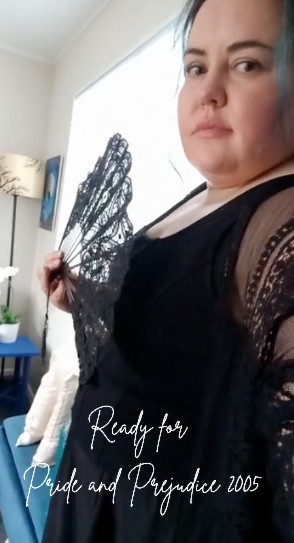
In 2005 I watched the movie at Reading Cinemas in Courtney Place (closed since 2019 but rumour has it that it’ll reopen) which was conveniently next door to my office. I refuse to comment on whether I skipped out during a work day to watch an Austen movie for the first time in a theatre. Today I’ll watch it from a reclining seat at the Queensgate movie theatre, appropriately attired.

If you love Jane Austen check out the upcoming events for the Austen Society

Emma is Clueless

Cher is clueless about her feelings for Josh – just as her regency counterpart, Emma, is clueless about her feelings for Mr Knightley. Emma is unaware that her determination not to marry is because she’s in love with Mr Knightley, her heart is reserved for him.

Video from Clueless

Audio from The Alchemy by Taylor Swift

Video from Emma (1996)

Audio from The Alchemy by Taylor Swift

If you didn’t know Clueless is based on Jane Austen’s Emma – where have you been?? It’s an appropriate title considering Emma thinks she knows what’s best for everyone but she really has no idea.

If you’d like to discuss Austen with me you can book a time

Published
Categorised as Austen

What a Man Should Be

This weekend I participated in a discussion with JASNA Eastern Washington and Northern Idaho Region entitled “What a man should be” based off this quote from Emma:

“So unlike what a man should be!—None of that upright integrity, that strict adherence to truth and principle, that disdain of trick and littleness, which a man should display in every transaction of his life.”

Emma’s talking about Frank Churchill but who she’s describing is Mr Knightley. It’s not the first time she compares Mr Knightley to other men —consciously, or unconsciously as she does here.

When Emma is disappointed with Mr Weston, she again (unconsciously) describes Mr Knightley: “General benevolence, but not general friendship, made a man what he ought to be.” Then she adds as an afterthought; “She could fancy such a man.” Austen is making a joke that will take the length of the book to pay off.

At the ball Emma compares his figure to the men around him, unaware that she’s describing her attraction to him. “His tall, firm, upright figure, among the bulky forms and stooping shoulders of the elderly men, was such as … must draw every body’s eyes; and, excepting her own partner, there was not one among the whole row of young men who could be compared with him.”

When she’s telling Harriet that Robert Martin doesn’t have the manners of a gentleman she says; “..Mr. Knightley’s downright, decided, commanding sort of manner, .. suits him very well; his figure, and look, and situation in life seem to allow it..”

At the Cole’s party, Emma remarks to Mrs Weston; “I know no man more likely than Mr. Knightley …to do any thing really good-natured, useful, considerate, or benevolent. He is not a gallant man, but he is a very humane one…” In deference to Mr Knightley’s integrity she tells Harriet, though it pains her to do so, that he “is the last man in the world, who would intentionally give any woman the idea of his feeling for her more than he really does.”

Austen provides a comparison between Mr Elton and Mr Knightley. Emma thinks to herself that Mr Elton “is almost too gallant to be in love.. he does sigh and languish, and study for compliments rather more than I could endure.” But when Mr Knightley proposes he says “I cannot make speeches, Emma” .. in a tone of such sincere, decided, intelligible tenderness as was tolerably convincing.—“If I loved you less, I might be able to talk about it more.”

Emma admires Mr Knightley’s integrity, how he manages relationships, his figure, his manners, his character and his honesty.

Want to discuss Austen further with me? check out the details

Published
Categorised as Austen

The Kids Table

Image from I Bet You Think About Me by Taylor Swift

We’re awkwardly aware of the age gap between Mr Knightley and Emma – 16 years makes us uncomfortable. It gets worse when Harriet develops a crush, a full 20 years, making Mr Knightley more eligible to be her father than her husband. His companions are often younger; his brother and sister in law, both Mr and Mrs Elton, Robert Martin, and Mrs Weston may be younger than him also. Exceptions are Mr Woodhouse, Mr Weston and Miss Bates who have elements of childishness in their characters. Mr Knightley might be the only real adult in Highbury.

In chapter 41 it feels like Mr Knightley is sitting at the kids table. “[P]laced as to see them all”, he witnesses Emma and Frank’s games, morphing into a disappointed parent (a role he often slides into with Emma) observing their treatment of Jane. He suspects Frank of “double dealing”, of an “inclination to trifle with Jane Fairfax.” Emma is too caught up in Frank’s attention to herself and her schemes of “making him over to Harriet” to observe clearly. Mr Knightley’s senses have been sharpened by his jealousy of Frank.

The image is from Taylor Swift’s music video I Bet You Think About Me, it looks as though she’s telling the children to behave but, if you’ve seen the video, she’s there to corrupt them, clearly indicated by her bright red dress in comparison to the pure white of the children’s dresses (almost copies of each other).

You’re welcome to book a time to discuss Austen with me

#taylorswift #mrknightley #emma #janeausten

Published
Categorised as Austen

Lady Susan Ruins Everyone’s Lives

Lady Susan has an amazing ability to waltz into a situation and mess it up for everyone. Mrs Mainwaring loves her husband who loves Lady Susan, she is “insupportably jealous and so enraged against” Lady Susan that it is “time for (her) to be gone.”

Sir James Martin is (probably) in love with both Vernon ladies and devastated when they leave Langford in this scene though in the book he’s the one that leaves.

Lady Susan “bestowed a little notice” on Sir James Martin, “in order to detach him from Miss Mainwaring” and managed to get him to “make proposals to (her) for Frederica” her daughter. Masterful.

Audio from Fortnight by Taylor Swift

Video from Love and Friendship (Lady Susan adaptation) by jane Austen

If you’d like to discuss Austen with me (possibly with a Swiftie slant?) you can book here

Published
Categorised as Austen

Jane Austen’s continuing relevance

Sunday Star Times 23/3/25

In the more than 200 years since Jane Austen published, people and society haven’t changed all that much (even though I’m writing this on a computer rather than with a quill).

She may be dead, but the patriarchy (sadly) isn’t. Austen lived in a time when it was hard(er) to be a woman; none of her novels bore her name during her lifetime, as it was considered scandalous for a woman to write, let alone earn a living. Let’s be honest: if we were talking about Shakespeare, there’d be no question of continuing relevance. Lydia Bennet is almost ruined by eloping, just as women are slut-shamed today. Lizzy Bennet might be called “mouthy” for daring to have an opinion, and Lady Catherine de Bourgh is recognisable as a micromanager.

The spectre of Napoleon loomed large during Austen’s life (and in her novels), exactly as a couple of male figureheads on the other side of the globe do for us now. Our more connected and mobile world means we are as affected by their decisions as she was by someone just across the channel.

Marriage for financial security, depicted in Austen’s novels, may be making a comeback. In the current climate, with increased economic pressures and uncertainty, it could be argued that you can’t afford to choose a partner without considering their finances. Charlotte Lucas has no affection for Mr Collins when they marry, but marriage is necessary for her survival.

Austen’s novels provide a sense of justice. Bad things happen, but they happen off-page, and everyone gets the ending they deserve (except perhaps Mr. Collins). Lizzy marries someone who appreciates her intelligence; Darcy gains a partner who will tell him off when he needs it. With the way things are going, it’s comforting to know that happy endings exist. 

Frances Duncan (she/they), of Te Whanau ā Apauni, writes Austen-inspired fiction, offers Austen-inspired Life Coaching, hosts The Amateur Austenite Podcast and founded the Jane Austen Society of Aotearoa New Zealand. (Obsessive, much?) On Instagram she creates videos of Austen adaptations paired with Taylor Swift lyrics. Her latest novel is Bag a Boyfriend a contemporary Pride and Prejudice set in a reality TV dating show.
The Jane Austen Society of Aotearoa New Zealand, which celebrated its tenth anniversary last year, will host a birthday party at Elixir in Chews Lane this December to celebrate Austen’s 250th birthday.

Instagram: https://www.instagram.com/francesduncandoes
Website: https://francesduncandoes.com
Society Website: https://janeaustensocietynz.wordpress.com

Published
Categorised as Austen

Book Review: Pride, Prejudice and Jasmin Field

Review of the Melissa Nathan novel

Jasmin Field is, almost accidentally, cast as Elizabeth Bennet on stage after she uses her anger at being called the “ugly sister” to give the director (famous actor Harry Noble) a telling off (still on script) during her audition.

Harry pretty quickly admires her “dark eyes” and the soul they are a window to he finds “compelling.” Of course, their story mirrors that of their stage counterparts (he’s not originally Darcy but you know he will be). When he gives her a ride home she berates him for not speaking, just as Lizzy did at the Netherfield Ball, “Do you offer people lifts to ignore them in a confined space?”

There are some excellent character descriptions:

The woman looked as if she had suddenly woken up one day and thought, How can I make myself as unattractive and possible? and come up with a damn fine answer.”

“the only 100% straight man who minced like a true thespian.”

Bridget Jones, another book with flavours of Pride and Prejudice and a journalist main character, is mentioned. This novel feels similar; women desperate for men (even though they know they shouldn’t be), diet culture and of course it’s also set in London. There’s something about the style, which may be due to the time it was written, that feels familiar.

True Austen irony crops up when at the audition Harry states that “It would damage my reputation to be seen at the same nightclub as most of these people, let alone direct them in a play,” and the novel ends with the after party in the nightclub where Harry is present.

The cast of characters is huge; those on and off stage have stories that parallel Austen’s but all seem blissfully unaware of it. But the reader can enjoy the anticipation of each plot point.

Perspective switches between characters within paragraphs. This tends to be a no-no in writing these days but I rather enjoy seeing into others motivations.

Despite being a product of it’s time (first published in 2000) this was a delight to read.

I’ll leave you with my favourite quote (apologies for the toilet humour):

Backstage was a dark terrifying place. As were Jazz’s bowels. She wondered if she could hide a toilet under her petticoat.”